
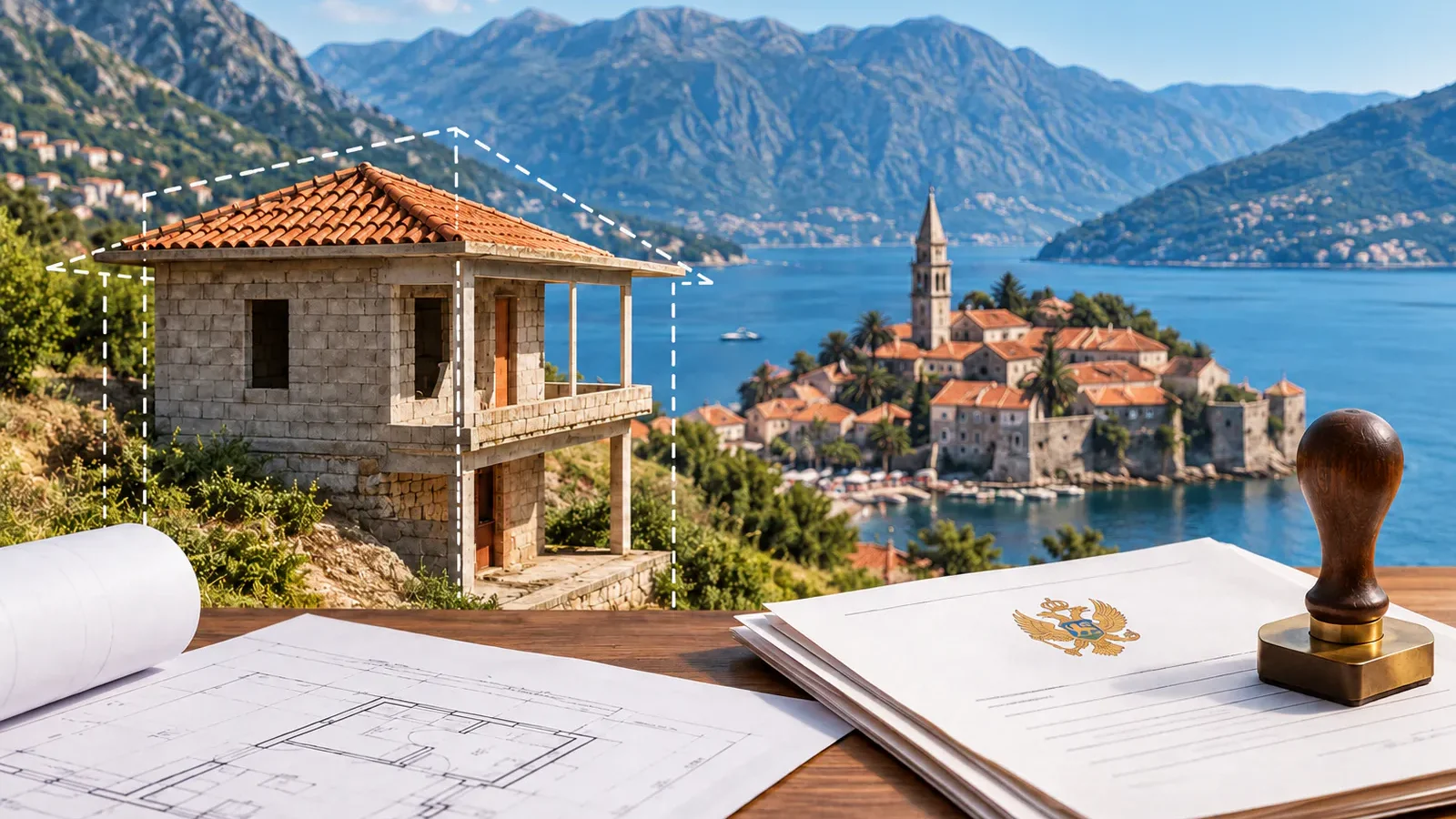
The short answer: if a house in Montenegro was built, extended or given an extra floor without a permit, it can now be legalized under a law in force since 14 August 2025. The first step is registering the building in the cadastre, and the deadline for that is 14 August 2027. Miss it and you face an annual fee, a ban on selling and, at worst, a demolition order.
Many old houses here share the same problem. They stand, but on paper they don’t exist. Somebody rebuilt them, added a room or a floor years ago and never got a permit. Now that follows the house into every sale, every inheritance and every plan to reconstruct it.
The law on the legalization of illegal buildings, adopted in August 2025, is probably the most important news for owners of older property in years. For the first time there is a real legal way to put things right. The catch is the deadline: it has already moved twice in a single year. Here is what the law covers, who decides, which dates apply now and what happens if you are late.
What counts as an illegal building?
Any structure, or part of one, that was built, reconstructed, extended or raised without a building permit. That is the law’s own definition, and it is broad on purpose.
If you have an old house that was altered at some point without paperwork, legalization is usually the only legal route. It also has to come first: you can’t start a new reconstruction until the status is sorted.
Which buildings can be legalized?
A building qualifies if it meets all of these conditions:
- it is visible on the satellite and aerial survey of the area (for Montenegro, this survey was made in July 2025);
- it is registered in the real estate cadastre;
- it does not stand on land that the plan reserves for structures of public interest;
- where there is no valid planning document for the area, it does not go beyond the regulation line or the boundary of the owner’s plot;
- ownership of the building is resolved.
Buildings in protected areas have extra conditions. They must have been built within the basic urban parameters or reference points of the valid plan and comply with the protection act for that natural site.
What if your house doesn’t show up on the 2025 survey? Then you have to prove it was there. The owner applies for certification of an as-built survey (elaborat premjera izvedenog stanja), attaches a structural engineer’s report and shows that the building stood before July 2025. This is set out in the consolidated text of the law.
There is also a simpler case. Buildings already recorded on the 2018 orthophoto are legalized under the current law, as long as two things are true: a legalization application has been filed, and nothing has been added or built on top since then. The gross floor area and the number of floors must match.
Who decides: the municipality or the ministry?
It depends on the size and type of the building:
- the municipality decides on buildings of up to 500 m² net floor area and on some protected areas;
- the central government handles buildings over 500 m², most protected areas, hotels, and four- and five-star tourist settlements and resorts.
What is the deadline for legalization in Montenegro?
Strictly speaking, the deadline is for starting the process: an owner whose building is not yet in the cadastre has to apply for cadastre registration within a set period (Article 48). That period has changed twice in one year, so be careful with older articles online:
- the original law of August 2025 gave six months;
- the February 2026 amendments (SL CG 18/2026, in the register) extended it to 12 months. That is where the date of 14 August 2026 came from, which the ministry reminded owners of on 3 June 2026;
- the August 2026 amendments (SL CG 117/2026, in force from 15.08.2026) replaced "12 mjeseci" with "24 mjeseca" in Article 48.
So, as of autumn 2026, the last day to apply for cadastre registration is 14 August 2027. The Real Estate Administration confirmed the new date when the extension was announced.
The extension came with a stricter rule. You used to be able to "hold" the deadline with a partial file. Not any more: the Real Estate Administration (Uprava za nekretnine) now wants the complete set at once, including the as-built survey.
One more thing owners often mix up: cadastre registration is not legalization. It is the step that opens the door, and without it the legalization procedure cannot even start. Legalization itself is granted by a separate decision (rješenje o legalizaciji), and the right to it does not expire with the cadastre deadline. The ministry’s state secretary said so plainly on RTCG’s Okvir programme: you can apply for legalization even after the registration deadline.
What happens if you miss the deadline?
This is not a theoretical question. Plenty of owners won’t make it by 14 August 2027. The law spells out three consequences, plus one separate route.
Demolition. The wording is harsh and it is in the law itself: if registration was not started in time, the spatial protection inspector must issue a demolition order.
An annual fee. If the building is on the orthophoto but no legalization application has been filed, the owner pays a fee for the use of space (naknada za korišćenje prostora). It is charged every year until the building is legalized or removed, and the local authority sets the amount.
A legal freeze. Without cadastre registration and a legalization decision, the building cannot be sold or otherwise transferred (otuđiti). The house is still there; you just can’t sell it. Some things do carry on. Business use gets more leeway: the February 2026 amendments allow it for another 36 months from the date they came into force. And even where the cadastre carries restrictive notes, the law expressly allows a mortgage or pledge, an out-of-court sale, a lease and inheritance.
The separate route. If a legalization procedure had already started and was then terminated by a decision, the local authority must review the conditions and continue it on its own initiative (ex officio). If no application was ever filed, nothing continues by itself. And don’t treat this as a plan B: the same law still gives the inspector grounds for both demolition and the fee.
So missing the deadline doesn’t close the door - legalization stays possible. But between "on time" and "late" sits a stretch of obligations, fees and risks that can end in demolition. Waiting to see what happens makes no sense. The sooner you start, the less time you spend exposed.
Why does the deadline keep moving?
Because far more people applied than anyone could process. Owners filed 6,105 applications in 2025 and 8,000 in just the first five months of 2026, according to RTCG. The Union of Municipalities (Zajednica opština) warns of a backlog: some files may not be reviewed in time, although applications will still be accepted and documents can be added later.
That also explains the stricter rules. Asking for a complete file up front is an attempt to stop the deadline being pushed back a third time.
Where to find official information
The official portal of the Legalization Administration (Uprava za legalizaciju) is legalizuj.me. It lists what you need: the application, the as-built survey and proof of cadastre registration, plus photographs of every facade (JPG, at least 5 megapixels - you can take them yourself).
The ministry’s line is simple: people get a chance to legalize what was built illegally, and from now on there will be zero tolerance for new illegal construction.
Questions owners ask
Can I sell a house that hasn’t been legalized?
No. Without cadastre registration and a legalization decision, the building cannot be sold or otherwise transferred. A mortgage or pledge, an out-of-court sale, a lease and inheritance are still allowed.
Is cadastre registration the same as legalization?
No. Registration is the first step and the precondition for legalization. Legalization itself is granted later, by a separate decision (rješenje o legalizaciji).
Can I still legalize after 14 August 2027?
Yes, the right to legalization does not end with the cadastre deadline. But a late owner risks an annual fee for the use of space and a demolition order from the inspector, so it is far safer to start before the deadline.
What documents do I need?
The application, a certified as-built survey and proof of cadastre registration, plus photographs of all facades (JPG, at least 5 megapixels). Since August 2026 the complete set must be submitted at once.
My house is not on the 2025 satellite survey. What now?
You can prove it existed. Apply for certification of an as-built survey with a structural engineer’s report and evidence that the building stood before July 2025.
In short
The new law gives old buildings a real chance to come out of the shadows. One date matters: start cadastre registration before 14 August 2027 (amendments 117/2026). That is less than a year away. Once the status is in order, you can sell, pass the house on, run a business in it or extend it. And don’t leave it to the last few months - the queue is already long.
After legalization, every project starts with the planning conditions for the plot: see UTU in Montenegro: What You Can Build on Your Plot. And if the next step is rebuilding the house, that is what we do at ABRIS.
Sources
- Zakon o legalizaciji bespravnih objekata (SL CG 91/25 od 06.08.2025)
- Zakon o legalizaciji bespravnih objekata, konsolidovani tekst
- Sl. list CG: izmjene ZLBO 117/2026 od 07.08.2026
- Sl. list CG: izmjene ZLBO 18/2026 od 13.02.2026
- MDUP (gov.me): Rok za upis u Katastar, 14.08.2026
- RTCG (05.06.2026): Upis do 14. avgusta, legalizacija moguća i nakon roka
- legalizuj.me
- Investitor.me (03.08.2026): rok produžen do 14.08.2027
- MDUP (gov.me): Usvojen predlog Zakona o legalizaciji